Teardown #003 · Channel · 10 June 2026
SpongeBob has been live in Fortnite for nine months. The data shows what a brand actually buys with a "good" island.
Day-2 retention: −8%, where weak activations lose 90%+ overnight. A single content drop recalled 24× the dormant audience.
Brand Island Teardown #003 · Super Motion Collective · 10 June 2026
The verdict in 30 seconds
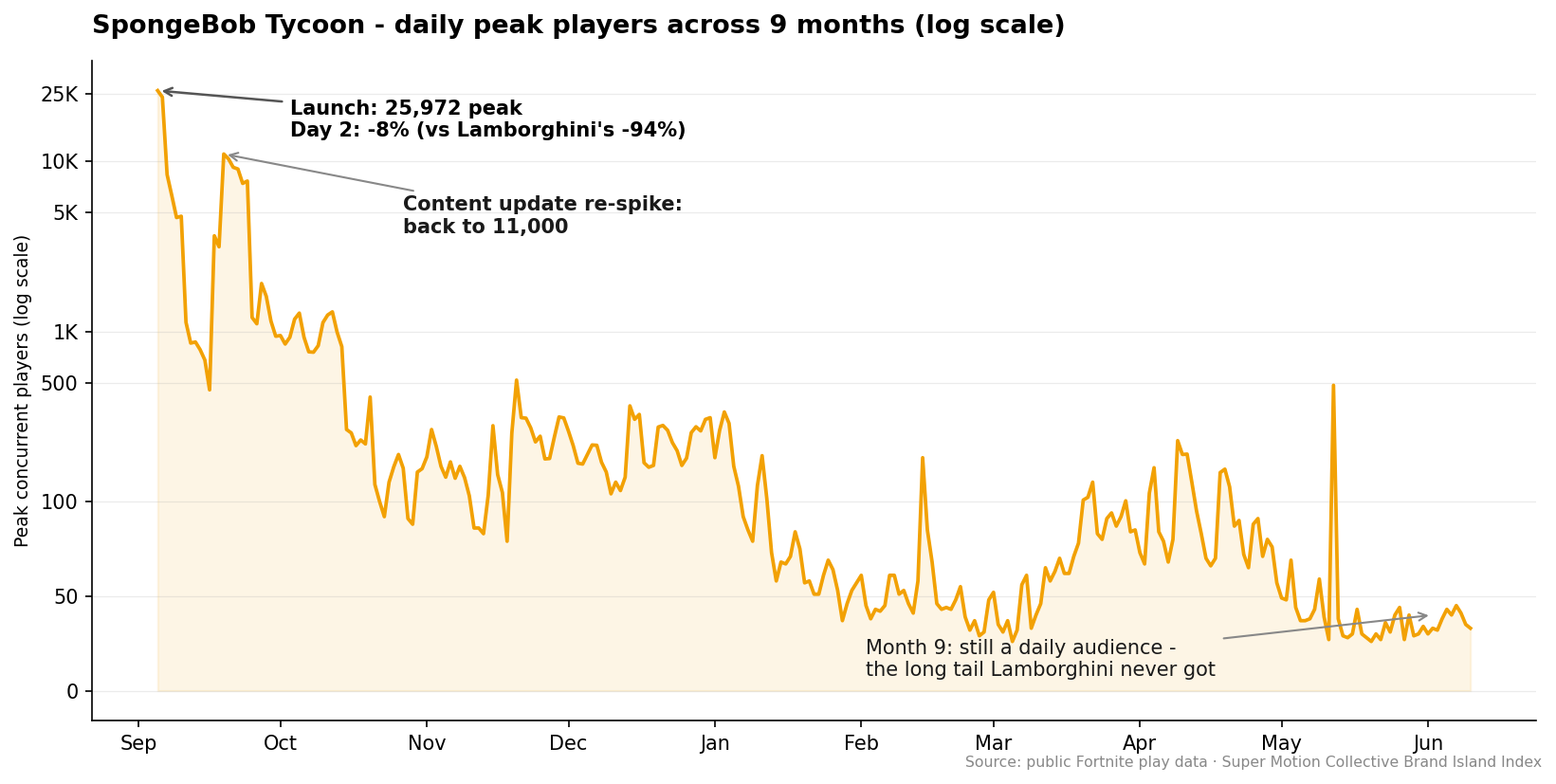
What happened: "SpongeBob Tycoon" launched 5 September 2025 under Paramount's official publisher account, built by Alliance Studios. Launch-day live audience: 25,972 simultaneous players. The day after: down just 8% — where weak activations lose 90%+ overnight. Nine months later it still draws a daily audience, with content updates repeatedly pulling it back up the charts.
Why: A retention-genre build (tycoon/progression) plus periodic updates turned a launch into a permanent branded channel — the thing "persistent world" campaigns promise and rarely deliver.
The takeaway for brands: the launch number is the least interesting thing this island produced. The asset is 279 consecutive days of brand presence that re-activates on demand.
Translating the numbers (the 60-second primer)
| Gaming metric | What it means in media terms | SpongeBob Tycoon |
|---|---|---|
| Peak CCU | Simultaneous live attendance | 25,972 at launch |
| Day-2 retention of audience | Did the audience come for the brand moment or the experience? | −8% day two (the failure benchmark is −90%+) |
| Update re-spikes | Owned-media moments: audience recalled with content, not ad spend | ~450 back to 11,000 with the first update (24x); visible bumps for months |
| The long tail | Always-on brand presence — a channel, not a campaign | A daily audience every single day for 9 months |
The day-two number is the tell. Lamborghini's Fast ForWorld lost 94% of its launch audience overnight; SpongeBob lost 8%. Same platform, same year, same "branded world" promise — entirely different outcome, and the difference was visible within 48 hours of launch. (That's also a practical point for brand teams: you know by Wednesday whether your activation has a future, and the public data tells you.)
What worked
The decay is graceful because the game loop holds people. Tycoon progression gives every session a reason to have a next session. The audience that stayed wasn't loyal to SpongeBob — it was hooked on the loop, wrapped in SpongeBob. That distinction is the craft.
Updates function as a re-activation button. Two weeks post-launch, an update pulled the audience from a low of ~450 back to 11,000 — a 24x recall without media spend. Smaller bumps repeat across the whole nine-month series. Each one is the brand re-entering culture for the cost of a content drop. No other media buy works this way: you can't re-run a TV spot and get the audience back for free.
Nine months of continuous presence. Since September, there has never been a day without players inside Paramount's branded world. For an IP whose business is sustained audience affinity, that's not a campaign metric — that's a distribution channel. The cumulative engaged hours across the series dwarf what the launch week delivered.
Agency craft worth naming: Alliance Studios consistently produces this curve shape — our wider tracking shows a meaningfully higher share of their catalogue still alive months after launch than is typical for branded work. Builders matter, and the data can tell you who's good before you brief anyone.
Why this outlasted bigger budgets
The contrast with failed persistent worlds isn't budget or brand fame — SpongeBob Tycoon almost certainly cost a fraction of a flagship automotive build. The difference was sequencing: retention genre first, update calendar second, launch moment third. Activations that invert that order buy a press cycle and rent an empty world.
If you're planning an activation: three rules from this dataset
- Watch your day-2 number — and plan for it. −8% vs −90% is the difference between a channel and a stunt, and it's decided by what's in the build, not the media plan. Ask your studio: "what brings a player back tomorrow?" If the answer is scenery, renegotiate.
- Budget updates as media, not maintenance. A content drop that recalls 24x your dormant audience is the cheapest re-activation in your media mix. Put it in the media budget where it belongs, and tie drops to brand moments (premieres, seasons, drops).
- Think channel, not campaign. The real product here is 279 days of always-on branded presence that compounds. If your activation brief has an end date in the same quarter as the launch date, you're buying the most expensive week of a channel and throwing the rest away.
Methodology & honest limits
Daily peak-player history from public Fortnite play data (full 279-day series from launch); attribution from public sources and our agency tracking. We observe player behaviour only — no production costs, licensing terms, media spend, or Paramount's internal KPIs. Current daily audience is modest in absolute terms; the argument is about durability and recall economics, not scale.
Play it yourself / who made it
Island code: 7611-2152-7182 · Play it: fortnite.com/@spongebobplay/7611-2152-7182
Built by: Alliance Studios (with Zoned) · Publisher: @spongebobplay (Paramount)
Super Motion Collective tracks every brand and IP island in Fortnite — daily audience data, launch curves, and what they teach. We also build the kind of maps people come back to. [contact]