Teardown #004 · Event · 10 June 2026
Coachella proved event-synced Fortnite activations work. Then it went dark and paid the price twice.
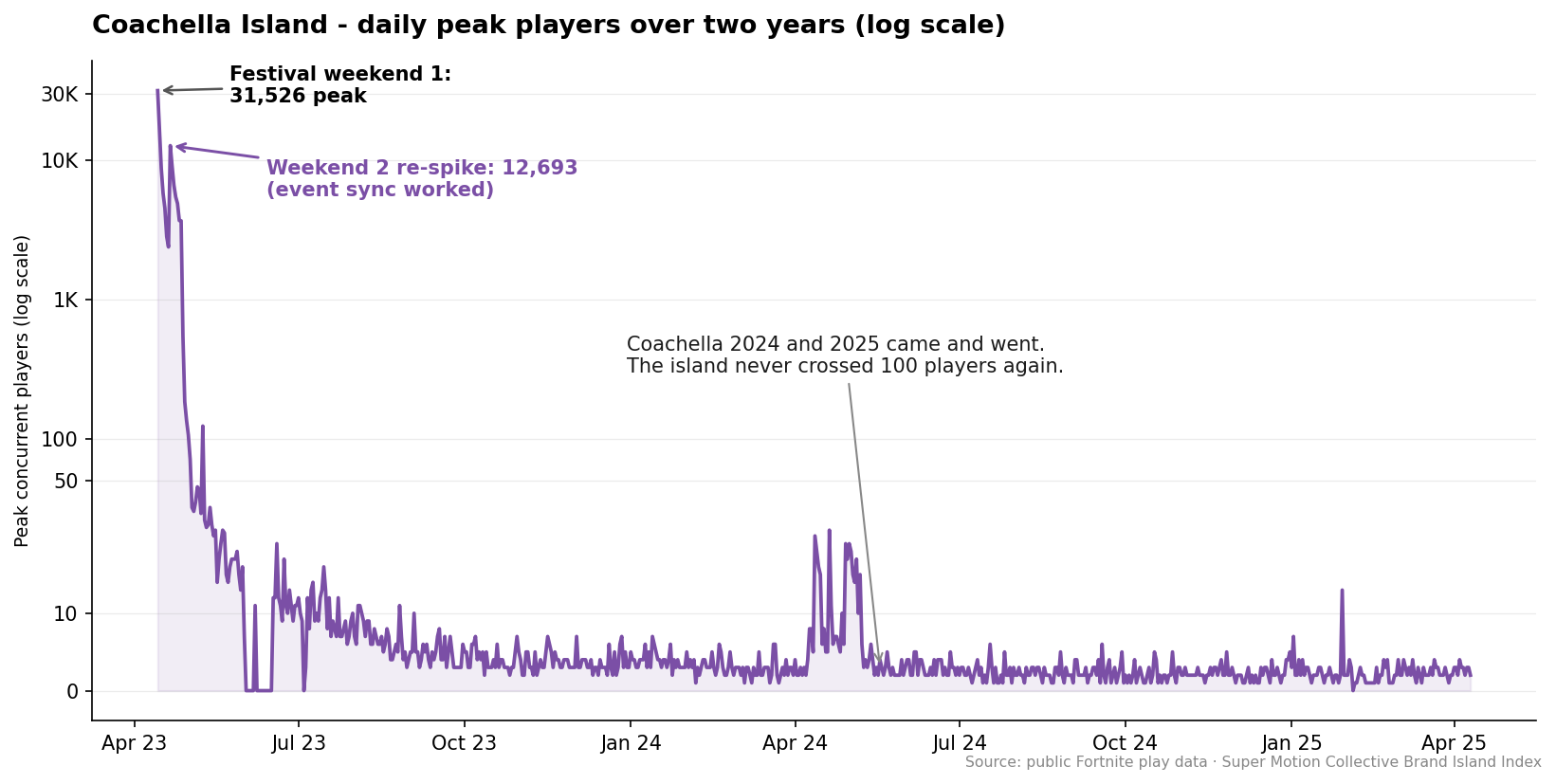
31,526 players on weekend one. 12,693 on weekend two. Then 700+ days under 100 — and a 2025 relaunch that peaked 17× lower. The Restart Tax, quantified.
Brand Island Teardown #004 · Super Motion Collective · 10 June 2026
The verdict in 30 seconds
What happened: Coachella Island launched on festival weekend 1, April 2023, under the festival's official publisher account. Live audience: 31,526 simultaneous players on day one — and a second spike of 12,693 exactly on festival weekend 2. Event-sync worked, twice, on cue. Then the island went dark: it never crossed 100 players again — sitting essentially empty through Coachella 2024. For Coachella 2025, instead of re-lighting it, the brand launched a brand-new island that peaked at 1,798 — 17x smaller than the original. The original has stayed dark through Coachella 2026.
Why: The activation was run as a two-weekend campaign with no plan for the other 50 weeks — and when the brand returned, it restarted from zero instead of re-lighting the audience it had already paid to build.
The takeaway for brands: an annual event is the best case for a Fortnite presence — a built-in re-activation calendar. Going dark between editions throws away the asset and pays what we call the Restart Tax.
Translating the numbers (the 60-second primer)
| Gaming metric | What it means in media terms | Coachella Island |
|---|---|---|
| Peak CCU | Simultaneous live attendance | 31,526 — stadium-scale, in-world, on festival weekend |
| Event re-spike | Audience recalled on schedule — proof the channel responds to your calendar | 12,693 on weekend 2 |
| The dark period | Channel equity left to expire | <100 players for 700+ consecutive days |
| The Restart Tax | Cost of relaunching cold vs. re-activating warm | 2025 relaunch peaked 17x lower than 2023 |
What worked — and it really worked
The 2023 launch is still one of the cleanest event-sync datasets we track. Two spikes, exactly on the two festival weekends, with meaningful audience both times. For a music brand whose entire business is concentrated into two April weekends, that's the medium behaving like a broadcast channel: turn it on, audience arrives; festival ends, attention moves on. Nothing wrong with that shape — if you plan for what happens next.
What the data shows next: the Restart Tax
Here's the expensive part. The 2023 island stayed technically live but creatively dark — no updates, no events, no reason to visit. Fortnite's discovery algorithm de-ranks dormant islands, so by the time Coachella 2024 arrived, the island was algorithmically invisible and the audience relationship had expired. For the 2025 edition the brand started over with a new island — new code, new discovery history, no inherited audience. It peaked at 1,798.
That 31,526 → 1,798 gap is the Restart Tax, and it's the quantified cost of treating a channel like a campaign. A modest content cadence between festivals — themed updates, lineup-reveal moments, archive performances — would have kept the original island warm, kept its algorithmic standing, and made every subsequent April cheaper and bigger than the last. Instead each edition starts the meter at zero.
If you're planning an event-linked activation: three rules from this dataset
- Your event calendar is a re-activation calendar — use it. Annual events are the single best fit for Fortnite presence because the recall moment is built in. Budget the between-period at minimum-viable cadence: one content beat a quarter keeps an island algorithmically alive for a fraction of launch cost.
- Never relaunch what you could re-light. A new island code starts from zero with the algorithm and the audience. Re-opening last year's island with fresh content inherits both. Make "same code, new content" the default and treat a new build as the exception that needs justifying.
- Decide the off-season plan before launch, not after. The two-weekend spike is bought with the build; everything after is strategy. If the brief ends at the event's end date, you are explicitly choosing to pay the Restart Tax next year — price that into the decision.
Methodology & honest limits
Daily peak-player history from public Fortnite play data — full series from April 2023 for the original island, April 2025 for the successor, both published under the festival's official account. We see player behaviour only: no licensing terms, internal goals, or sponsorship economics. If the 2023 island was scoped strictly as a one-edition activation, the launch itself should be judged a success — the analysis here is about the channel value left unclaimed afterwards.
Play it yourself / who made it
Original island (2023): 5449-4207-1280 · fortnite.com/@coachella/5449-4207-1280
2025 island: 9331-9321-5753 · fortnite.com/@coachella/9331-9321-5753
Publisher: @coachella (official) · Brand: coachella.com
Super Motion Collective tracks every brand and IP island in Fortnite — daily audience data, launch curves, and what they teach. We also build the kind of maps people come back to. [contact]